Allure Reporter
A WebdriverIO reporter plugin to create Allure Test Reports.
New Features
- Test Plan Support - Execute only specific tests defined in a test plan file
- Enhanced SDK Integration - Updated to use
allure-js-commonsv3.3.2 with improved performance - Better Cucumber Support - Improved handling of Cucumber scenarios and steps
- Enhanced Error Handling - More robust error reporting and debugging capabilities
Test Plan Feature
The Test Plan feature allows you to execute only specific tests defined in a JSON file. This is particularly useful for:
- Running subset of tests in CI/CD pipelines
- Parallel test execution
- Test prioritization
Configuration
Create a test plan file (.allure/testplan.json or testplan.json):
{
  "version": "1.0",
  "tests": [
    {
      "id": "test-001",
      "selector": "test/index.test.ts#should generate testplan.json"
    }
  ]
}
How Selectors Work
Test plan selectors work by matching against the test's fulltitle, which includes the file path and test name. The format is:
<file-path>#<test-name>
Examples:
test/index.test.ts#should generate testplan.json- matches specific test in specific fileLogin Tests- matches any test with "Login Tests" in the titleUser Registration- matches any test with "User Registration" in the title
The selector matching is flexible and supports:
- Exact matches - full test title
- Partial matches - substring of test title
- File-specific matches - include file path for precise targeting
Testplan
The test plan support can be enabled by providing ALLURE_TESTPLAN_PATH environment variable – the reporter automatically loads the test plan file and run tests which match the selectors.
ALLURE_TESTPLAN_PATH=/path/to/your/testplan.json
Usage Examples
Example 1: Running specific tests by file and test name
{
  "version": "1.0",
  "tests": [
    {
      "id": "login-001",
      "selector": "tests/auth.test.js#should login with valid credentials"
    },
    {
      "id": "login-002",
      "selector": "tests/auth.test.js#should reject invalid credentials"
    }
  ]
}
Example 2: Running tests by partial title match
{
  "version": "1.0",
  "tests": [
    {
      "id": "smoke-001",
      "selector": "Login Tests"
    },
    {
      "id": "smoke-002",
      "selector": "User Registration"
    }
  ]
}
Example 3: Running all tests in a specific file
{
  "version": "1.0",
  "tests": [
    {
      "id": "auth-suite",
      "selector": "tests/auth.test.js"
    }
  ]
}
Installation
The easiest way is to include @wdio/allure-reporter as a devDependency in your package.json.
{
  "devDependencies": {
    "@wdio/allure-reporter": "^7.0.0"
  }
}
You can simply do it by:
npm install @wdio/allure-reporter --save-dev
Configuration
Configure the output directory in your wdio.conf.js file:
export const config = {
    // ...
    reporters: [['allure', {
        outputDir: 'allure-results',
        disableWebdriverStepsReporting: true,
        disableWebdriverScreenshotsReporting: true,
        addConsoleLogs: true, // Attach console logs to reports
        reportedEnvironmentVars: {
            'NODE_VERSION': process.version,
            'BROWSER': 'chrome'
        }
    }]],
    // ...
}
Configuration Options
-
outputDir- defaults to./allure-results. After a test run is complete, you will find that this directory has been populated with an.jsonfile for each spec, plus a number of.txtand.pngfiles and other attachments. -
disableWebdriverStepsReporting- optional parameter (falseby default), in order to log only custom steps to the reporter. -
issueLinkTemplate- optional parameter, in order to specify the issue link pattern. Reporter will replace{}placeholder with value specified inaddIssue(value)call parameter. The same logic is applied if Cucumber is used and tagissueis set at any level, it will be converted to the link in the report. The parameter value example:https://example.org/issue/{} -
tmsLinkTemplate- optional parameter, in order to specify TMS (Test Management System) link pattern. Reporter will replace{}placeholder with value specified inaddTestId(value)call parameter. The same logic is applied if Cucumber is used and tagtestIdis set at any level, it will be converted to the link in the report. The parameter value example:https://example.org/tms/{} -
disableWebdriverScreenshotsReporting- optional parameter (falseby default), in order to not attach screenshots to the reporter. -
useCucumberStepReporter- optional parameter (falseby default), set it to true in order to change the report hierarchy when using cucumber. Try it for yourself and see how it looks. -
disableMochaHooks- optional parameter (falseby default), set it to true in order to not fetch thebefore/afterstacktrace/screenshot/result hooks into the Allure Reporter. -
addConsoleLogs- optional parameter (falseby default), set to true in order to attach console logs from step to the reporter. -
reportedEnvironmentVars(type:Record<string, string>) - Set this option to display the environment variables in the report. Note that setting this, does not modify the actual environment variables. -
includeVersionInHistoryId- optional parameter (falseby default). AllurehistoryIdis derived from the test title plus the browser or device family (chrome,iphone 12, …), not the workercidand not the browser/OS version. That keeps trends stable when Chrome or a mobile OS updates between runs. Vendor aliases such asGoogle Chrome/googlechromeandmsedge/Microsoft Edgeare collapsed to the same family. Allure still records the full version on the test as abrowser/deviceparameter. Set this totrueonly if you run the same test against multiple versions of the same browser or device (for example iOS 14 vs iOS 15 on an iPhone 12) and need separate history trends per version.
Supported Allure API
Core API Functions
addLabel(name, value)- assign a custom label to testaddFeature(featureName)– assign features to testaddStory(storyName)– assign user story to testaddSeverity(value)– assign severity to test, accepts one of these values: blocker, critical, normal, minor, trivialaddTag(value)– assign a tag label to testaddEpic(value)– assign an epic label to testaddOwner(value)– assign an owner label to testaddSuite(value)– assign a suite label to testaddSubSuite(value)– assign a sub suite label to testaddParentSuite(value)– assign a parent suite label to testaddIssue(value)– assign issue id to testaddAllureId(value)– assign allure test ops id label to testaddTestId(value)– assign TMS test id to test
Attachments and Content
addAttachment(name, content, [type])– save attachment to test.name(String) - attachment name.content– attachment content.type(String, optional) – attachment MIME-type,text/plainby default
addArgument(name, value)- add an additional argument to testaddDescription(description, [type])– add description to test.description(String) - description of the test.type(String, optional) – description type,textby default. Values ['text', 'html','markdown']
Steps API
addStep(title, [{content, name = 'attachment'}], [status])- add step to test.title(String) - name of the step.content(String, optional) - step attachmentname(String, optional) - step attachment name,attachmentby default.status(String, optional) - step status,passedby default. Must be "failed", "passed" or "broken"
startStep(title)- start with a steptitle(String) - name of the step.
endStep(status)- end with a stepstatus(String, optional) - step status,passedby default. Must be "failed", "passed" or "broken"
step(name, body)- starts step with content function inside. Allows to create steps with infinite hierarchybody(Function) - the step body async function
Usage
Allure Api can be accessed using:
CJS
const allureReporter = require('@wdio/allure-reporter').default
ESM
import allureReporter from '@wdio/allure-reporter'
Mocha example
describe('Suite', () => {
    it('Case', () => {
        allureReporter.addFeature('Feature')
    })
})
Cucumber
Basic Cucumber example:
Given('I include feature and story name', () => {
    allureReporter.addFeature('Feature_name');
    allureReporter.addStory('Story_name');
})
Custom steps
step method simplifies dealing with steps because each step present as an async function with any content inside.
The first argument of the function is the current step, that has most of the allure API methods (such as label, epic, attach etc):
allureReporter.step('my step name', async (s1) => {
    s1.label('foo', 'bar')
    await s1.step('my child step name', async (s2) => {
        // you can add any combination of steps in the body function
    })
})
Cucumber Tags
Cucumber tags with special names (issue and testId) are converted to the links (the corresponding link templates must be configured before):
@issue=BUG-1
@testId=TST-2
Feature: This is a feature with global tags that will be converted to Allure links

  @issue=BUG-3
  @testId=TST-4
  Scenario: This is a scenario with tags that will be converted to Allure links
    Given I do something
Cucumber tags with special names (feature) are mapped to Allure labels:
Feature: Test user role

  @feature=login
  Scenario: Login
    Given I test login
Displaying the report
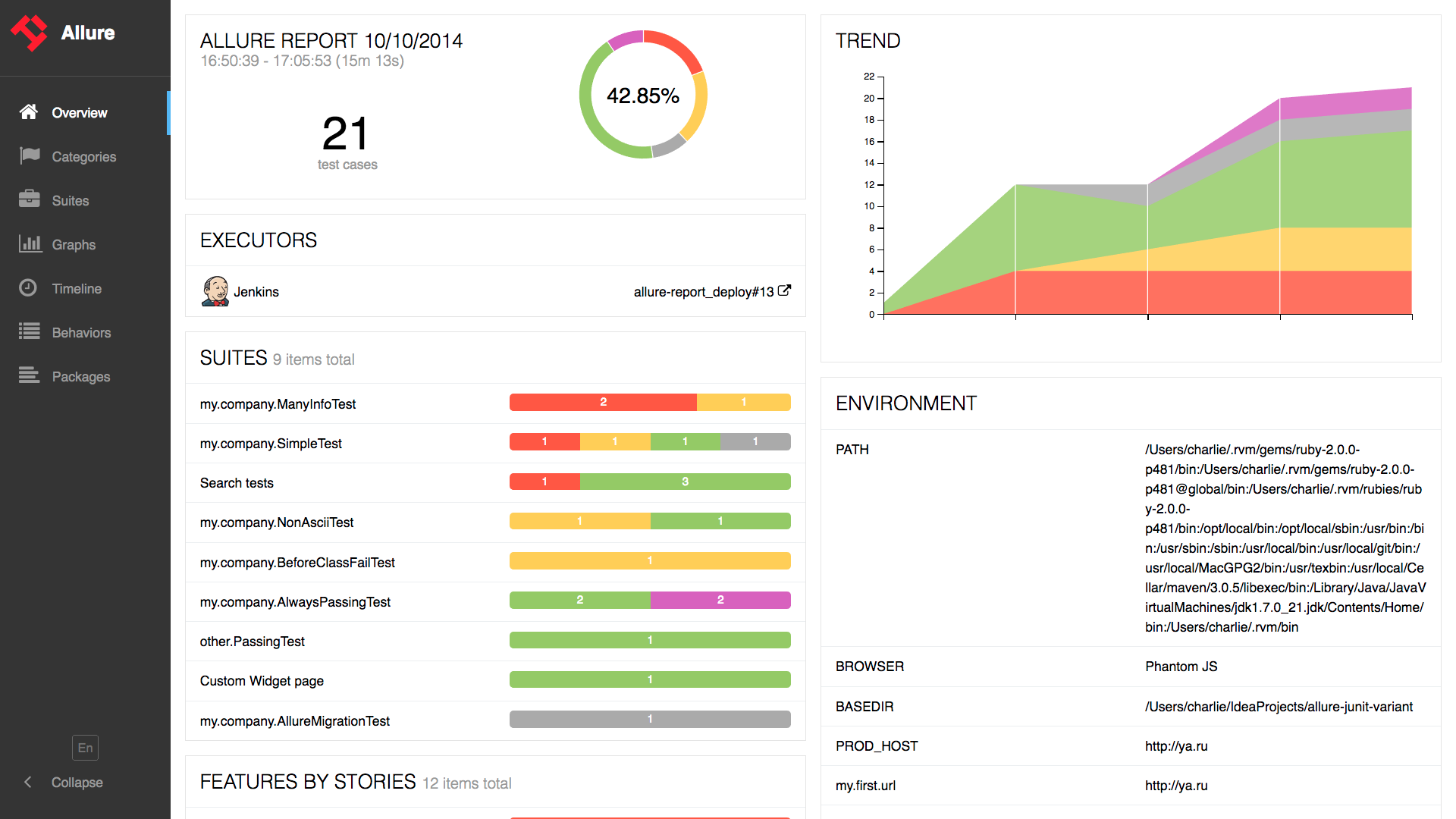
The results can be consumed by any of the reporting tools offered by Allure. For example:
Command-line
Install the Allure command-line tool, and process the results directory:
allure generate [allure_output_dir] && allure open
This will generate a report (by default in ./allure-report), and open it in your browser.
Autogenerate Report
You can also auto-generate the report by using the Allure command line tool programmatically. To do so install the package in your project by:
npm i allure-commandline
Then add or extend your onComplete hook or create a custom service for this:
// wdio.conf.js
const allure = require('allure-commandline')

export const config = {
    // ...
    onComplete: function() {
        const reportError = new Error('Could not generate Allure report')
        const generation = allure(['generate', 'allure-results', '--clean'])
        return new Promise((resolve, reject) => {
            const generationTimeout = setTimeout(
                () => reject(reportError),
                5000)

            generation.on('exit', function(exitCode) {
                clearTimeout(generationTimeout)

                if (exitCode !== 0) {
                    return reject(reportError)
                }

                console.log('Allure report successfully generated')
                resolve()
            })
        })
    }
    // ...
}
Jenkins
Install and configure the Allure Jenkins plugin
Add Screenshots
Screenshots can be attached to the report by using the takeScreenshot function from WebDriverIO in the afterTest hook for Mocha and Jasmine or afterStep hook for Cucumber.
First set disableWebdriverScreenshotsReporting: false in reporter options, then add in afterStep hook:
Mocha / Jasmine
afterTest: async function(test, context, { error, result, duration, passed, retries }) {
    if (error) {
        await browser.takeScreenshot();
    }
}
Cucumber
afterStep: async function (step, scenario, { error, duration, passed }, context) {
  if (error) {
    await browser.takeScreenshot();
  }
}
As shown in the example above, when this function is called, a screenshot image will be attached to the allure report.
Compatibility
- Allure: Compatible with Allure Framework 3.x
- Parallel mode: supported with Mocha
parallelMode.before()andafter()fixtures show once per test, as they run once per test. Not supported with CucumberparallelModeyet.
Getting Help
- Check the Allure documentation
- Report issues on Webdriverio or Allure3
